

Summary: This blog explains what specialist care at home means and how it can support people living with dementia, Parkinson’s, stroke-related needs, and complex neurological conditions. It focuses on how care must adapt at home as needs change, how families decide between home and residential care, and what to look for when choosing a specialist home care provider.
For many families, the need for specialist care doesn’t arrive with a clear label or a single decision. It develops gradually, alongside a growing sense that things are becoming harder to manage.
You may be supporting a loved one at home and doing your best to adapt as their needs change. Dementia may be affecting behaviour or understanding in new ways. Parkinson’s symptoms may be progressing, making movement, medication, and everyday tasks more challenging. Or a stroke may have changed life suddenly, leaving you unsure what safe, effective care at home now looks like.
At this stage, families often begin to ask quieter questions. Not about care packages or services, but about what is realistically possible.
Can my loved one still be supported at home, even as their needs become more complex?
It is usually around this point that the term specialist care at home is introduced. It can sound reassuring, but also vague. What makes care “specialist”? How is it different from standard home care? And how do you know whether it is the right level of support for dementia, Parkinson’s, stroke recovery, or other complex needs?
This blog is a practical guide to those questions. It explains how specialist care at home works and why it can allow people with complex needs to remain safely and meaningfully at home.
When Home Care Starts to Feel More Complicated at Home
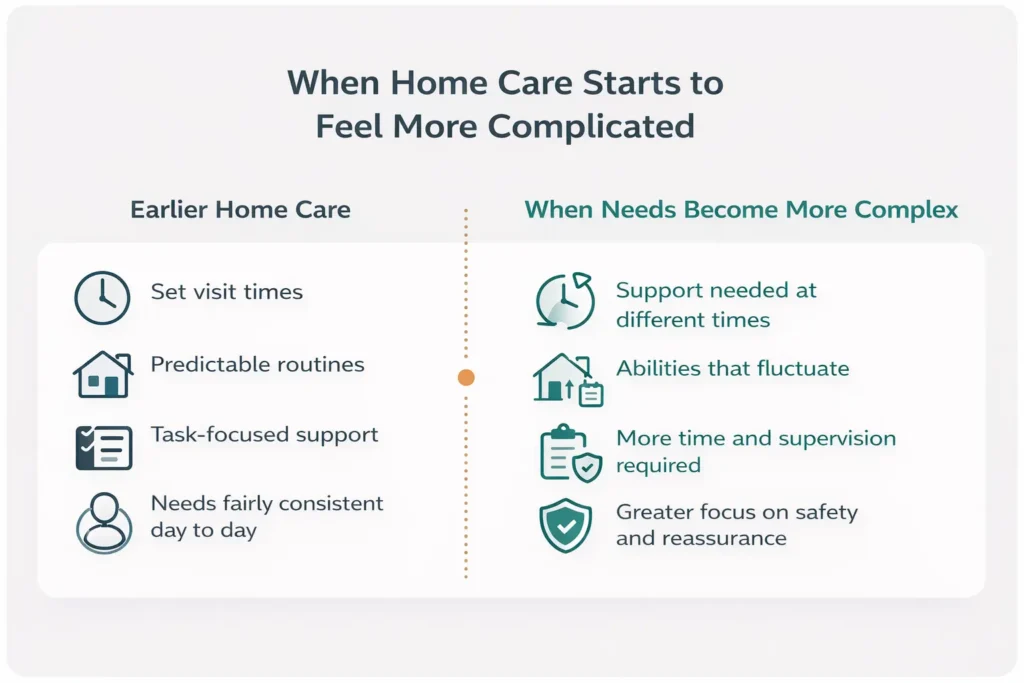
By the time families reach this stage, they are often already doing a lot right. Care is in place, routines exist, and everyone is trying to adapt. What has changed is the level of complexity involved.
Support that once felt sufficient may no longer stretch far enough. Care visits might not cover everything that is now needed, and everyday tasks such as personal care, moving safely around the home, managing continence, or preparing meals can take more time and closer supervision.
New challenges may also appear that standard home care is not designed to manage. Dementia can bring distress or agitation that feels difficult to respond to. Parkinson’s symptoms can fluctuate, meaning someone may cope well one moment and need significant help the next. After a stroke, recovery often involves navigating physical, cognitive, and emotional changes at the same time.
As a result, practical worries tend to increase. Families start to question safety, medication, mobility, and what might happen outside planned care visits. This is usually the point where it becomes clear that the question is not whether care is needed, but whether the care in place is specialist enough. Needs have not moved beyond home. They have moved beyond standard support.
What Specialist Care at Home Really Means
At its simplest, specialist care at home means care that is shaped around complex, changing needs, rather than a fixed list of tasks. It is designed for situations where a condition affects not just what support is needed, but how that support must be given at home.
Standard home care is often task-focused, following set routines such as washing, dressing, meals, or medication prompts. For many people, this works well. When needs become more complex, however, the way care is delivered becomes just as important as the tasks themselves.
Specialist care at home reflects this difference. It is built on a deeper understanding of conditions such as dementia, Parkinson’s disease, stroke, and other neurological or complex needs. This includes recognising changes in communication, behaviour, mobility, and emotional wellbeing, and responding to them in a way that supports daily life at home.
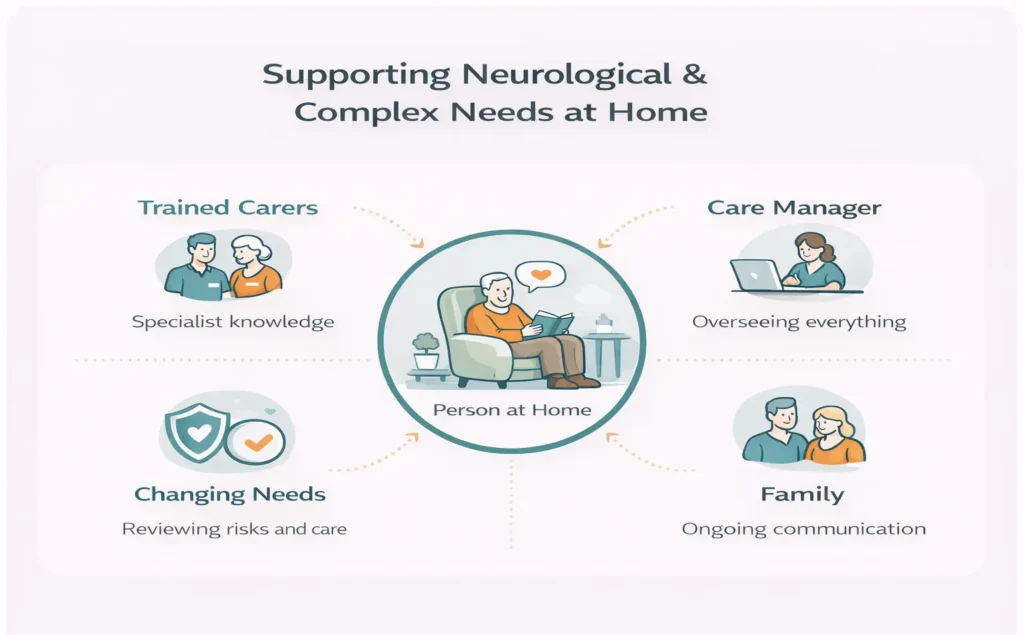
Another key difference is training and oversight. Specialist Carers are equipped to respond calmly to distress, confusion, mobility changes, and risk, adapting their approach as situations change. Their work is overseen by experienced Care Managers, who review care plans regularly, identify risks early, and support families as needs evolve.
For families, specialist care at home is not about making care feel medical. It is about bringing the right level of understanding, consistency, and coordination into the home, so complex needs can be met safely and with dignity.
Why Some Conditions Need a More Specialist Approach to Care at Home
Some conditions place demands on care that standard home support is not always designed to meet. This is not simply because they are serious, but because they change how care needs to be delivered and adapted at home.
Conditions such as dementia, Parkinson’s disease, and the effects of stroke often involve a mix of physical, cognitive, and emotional changes. These do not progress in a straight line. Someone may cope well in one area of daily life while struggling in another, or need very different levels of support from one day to the next.
Because of this, care at home needs to be flexible rather than fixed. Dementia care may require carers who know how to reduce distress without confrontation. Parkinson’s care often depends on close attention to timing, mobility, and fatigue. After a stroke, support may need to balance recovery, safety, and emotional adjustment at the same time.
Specialist care at home is built around these realities. Day-to-day delivery is shaped around patterns, risks, and changes linked to each condition, and adjusted as needs evolve. This is what allows people with complex needs to remain safely at home, supported by care that responds to complexity rather than being disrupted by it.
Dementia Care at Home When Needs Become More Complex
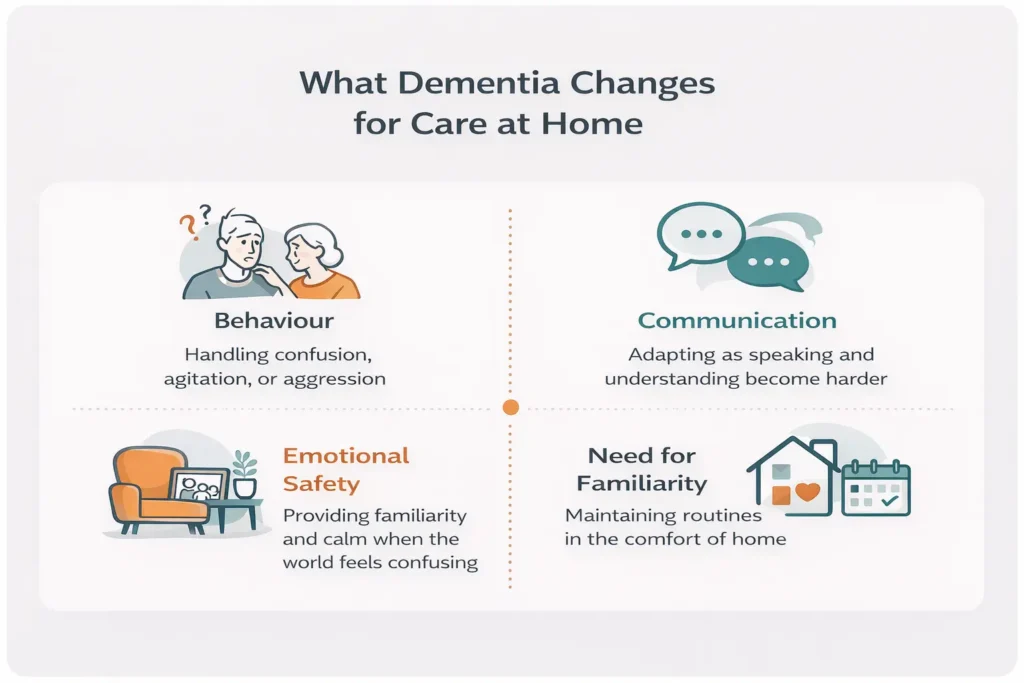
Dementia changes not only what support someone needs, but how that support must be given at home.
This matters because dementia often develops gradually. The Dementia Statistics Hub estimates that around 850,000 people are currently living with dementia in the UK, meaning many families find themselves adapting care at home over time, rather than facing a single, clear turning point.
As dementia progresses, care at home increasingly centres on behaviour, communication, and emotional safety, rather than practical tasks alone. Families may notice distress, agitation, or withdrawal becoming more common. The Alzheimer’s Society explains that these behaviours are often a response to fear, confusion, pain, or difficulty expressing needs.
Because of this, how care is delivered at home becomes just as important as what care is provided. Familiar routines, surroundings, and recognisable faces help people feel secure. Remaining at home can support this stability, but only when carers understand how to work with existing routines rather than disrupt them.
Specialist dementia care at home is shaped around these needs. Carers are trained to respond calmly to distress, interpret behaviour as communication, and adapt their approach day to day. This allows people to remain at home not simply because it is familiar, but because it is safe, supportive, and respectful of who they are.
Parkinson’s Care at Home as Symptoms Progress
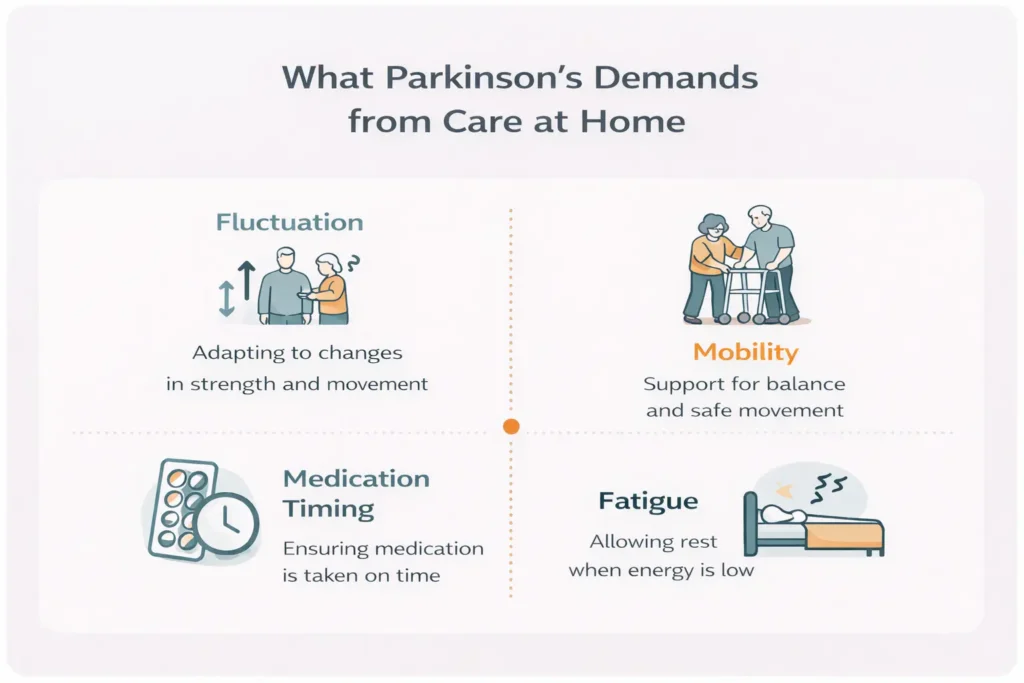
Parkinson’s is a long-term condition that often affects people in fluctuating ways. For many families, this means adapting care at home over time as abilities change.
Parkinson’s UK estimates that around 166,000 people in the UK are living with Parkinson’s (Parkinson’s UK). Day to day, this often looks like symptoms that vary across the course of a single day, placing particular pressure on how care at home is planned and delivered.
Mobility is often the most immediate challenge. Stiffness, balance problems, or freezing can increase the risk of falls, meaning someone may manage well at one point and need hands-on support later the same day. Care at home needs to respond to these changes as they happen.
Medication timing is also critical. Parkinson’s medication often needs to be taken at precise times, as delays or missed doses can quickly affect movement, comfort, and confidence. Fatigue can add to this, limiting what someone can safely manage as the day goes on.
Specialist Parkinson’s care at home brings these elements together. Support is shaped around daily life at home, allowing carers to adapt to changes and help people remain at home with greater safety, confidence, and independence.
Stroke Care and Recovery at Home After Hospital Discharge
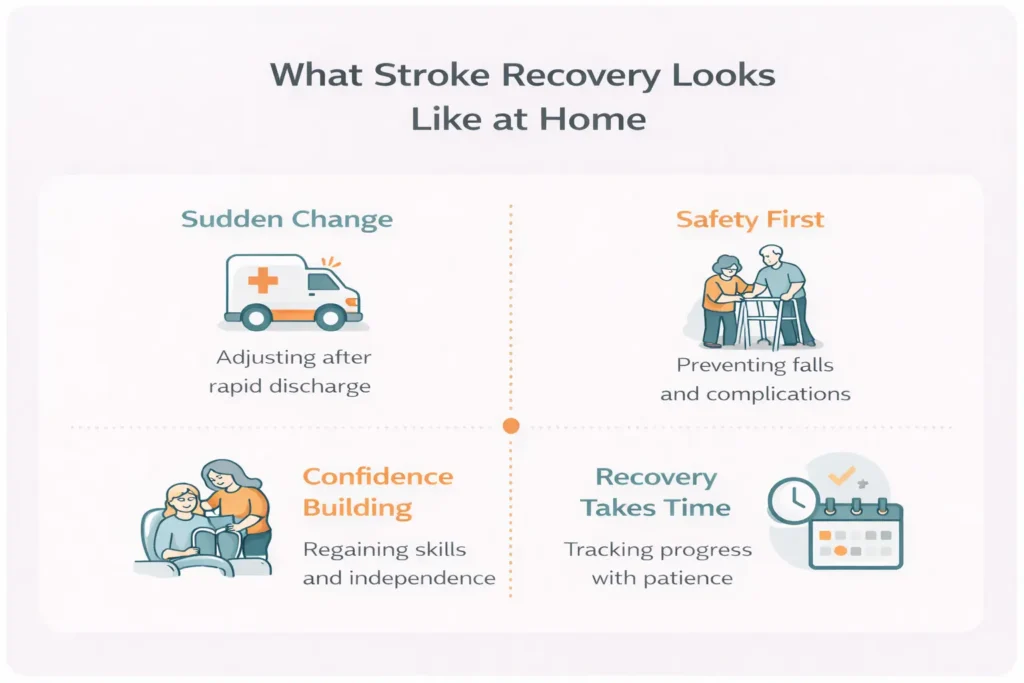
Stroke care at home often begins suddenly, following a short hospital stay and with little time to prepare. Unlike conditions that develop gradually, families are usually adjusting to a major change almost overnight.
This matters because stroke is one of the most common causes of long-term disability in the UK. NHS England reports 111,137 stroke admissions in England in 2023/24, and charities including the Stroke Association, estimate there are around 1.4 million stroke survivors nationwide, many of whom need ongoing support after discharge.
In the early weeks at home, care usually focuses on safety and confidence. Weakness, balance changes, or reduced coordination can make everyday movement risky, and tasks such as getting out of bed, using the bathroom, or preparing meals may need hands-on support.
Stroke can also affect communication, concentration, and mood. Frustration, low confidence, or withdrawal are common as people adjust, and these changes can be just as challenging as physical recovery.
Care after a stroke rarely stays the same. As recovery progresses, support often needs to adapt, balancing encouragement and independence with reassurance and safety. Specialist stroke care at home recognises this pattern, with Care Managers overseeing support so it evolves alongside recovery and helps people rebuild confidence at home.
Supporting Neurological and Complex Care Needs at Home
Some people live with more than one condition, or with needs that cut across physical, cognitive, and emotional boundaries. In these situations, care at home is rarely about managing a single diagnosis.
Research collated by Brain Research UK suggests that around one in six people in the UK lives with a neurological condition (Brain Research UK). This might include dementia alongside mobility problems, Parkinson’s with other long-term health issues, or complex needs following a stroke. Care needs to reflect how these challenges interact in everyday life at home.
Neurological and complex needs can increase risk. Changes in awareness, movement, or judgement may affect safety and independence in ways that are not always predictable. When issues are missed or support is inconsistent, small problems can escalate quickly.
Specialist care at home helps reduce this risk through coordination and oversight. Care is delivered as part of a joined-up plan, with Care Managers reviewing needs, guiding Carers, and adjusting support as circumstances change. This keeps care at home stable, even when needs are not.
For families, this means fewer crises and less constant firefighting. Care is planned with complexity in mind, making it possible for people with neurological and complex needs to remain at home with support that feels calm, responsive, and reliable.
Specialist Care at Home vs Residential Care – How Families Decide
For many families, this is one of the hardest decisions to face. Not because there is a right or wrong answer, but because it often comes at a time of exhaustion, uncertainty, and pressure.
Residential care can offer reassurance through on-site staff, structured routines, and an environment designed around care delivery. For some people, particularly those who need constant supervision or whose needs can no longer be met safely at home, a care home may be the right option.
At the same time, many families value what home represents. Familiar surroundings, personal routines, and a sense of independence often play a significant role in emotional wellbeing, especially for people living with dementia or neurological conditions. Specialist care at home can make it possible to retain these benefits while still addressing complex needs.
How families decide often comes down to practical questions rather than labels. Can care at home be adapted as needs change? Is there enough oversight and continuity to manage risk? Does the person feel calmer and more themselves at home, or do they benefit from a more structured environment?
What matters most is that the decision reflects the individual, not a sense of obligation or fear. With the right level of specialist support, home can remain a safe and appropriate option for many people. For others, residential care may provide greater reassurance. The goal is not to avoid one option or push another, but to find the setting that best supports safety, dignity, and quality of life at this stage.
What to Look for in a Specialist Home Care Provider
Once families begin exploring specialist care at home, the focus often shifts from whether support is needed to who should provide it. Knowing what to look for can make this stage feel clearer and less overwhelming.
Training and experience are a good starting point. Specialist care relies on Carers who understand the specific demands of conditions such as dementia, Parkinson’s, stroke, and complex neurological needs. This goes beyond basic care skills, and includes the ability to respond calmly to distress, changes in mobility, or unexpected situations.
Oversight and care planning matter just as much. High-quality specialist home care should be overseen by experienced Care Managers who know the individual well and understand how needs may change. Regular reviews, clear care plans, and early risk identification help ensure care remains appropriate as circumstances evolve.
Consistency and communication also play a key role. Knowing who is coming into the home, having a familiar care team, and feeling able to raise questions or concerns all help build trust. When care is delivered by a coordinated team that communicates well, families are more likely to feel confident that their loved one is being supported safely and with respect.
Taking the Next Step, at Your Own Pace
If you are reading this, it is likely because you are trying to work out what comes next for someone you care about. By this point, many families have already adapted again and again, often without realising how much responsibility they have taken on.
You do not need to make a decision straight away. For many people, the most helpful next step is simply to talk things through with someone who understands specialist care at home and the situations families face when needs become more complex.
A conversation can help you sense-check what you are seeing, understand what support could look like, and decide whether specialist care at home might be right now or something to consider later.
If you would like to talk to an expert who understands, our team is here to listen and offer clear, honest guidance based on experience. Sometimes, having one calm conversation is enough to bring clarity and reassurance.
Resources
- Dementia Statistics Hub – UK dementia prevalence and projections
- Alzheimer’s Society – Understanding dementia symptoms and behaviour
- Parkinson’s UK – Parkinson’s prevalence and statistics
- NHS England – Stroke admissions statistics (2023/24)
- Stroke Association – UK stroke survivor statistics
- Brain Research UK – Neurological conditions overview



With over 40 years of experience in the care industry, providing outstanding care has always been Helena’s core mission.
Helena has been a dedicated member of Unique Senior Care for eight years, starting as Care Manager and advancing to Head of Extra Care and now serving as Director of Operations.
She holds a Level 5 Diploma in Leadership for Health and Social Care and Children and Young People’s Services (England), as well as a Diploma in Welfare Services. Helena has completed various leadership and management courses, enhancing her expertise in the care industry.
Helena has authored published articles, including one for Skills for Care on managing change through the COVID pandemic. She has a steadfast commitment to advocating for and supporting those in need, ensuring their voices are heard and their rights upheld.