
Summary: This guide explains how to talk to someone with dementia in a way that feels calmer and easier for both of you. It covers why communication can become more difficult, how to reduce pressure in conversations, practical ways to speak more clearly, and what to do when conversations become challenging.
Conversations might be a little different when someone is living with dementia. You might notice pauses that weren’t there before, moments where words don’t quite come, or conversations that seem to go in circles, leaving you unsure how to respond.
It can feel uncomfortable and often you may wonder whether to step in, explain more, or keep things going. And when it doesn’t seem to help, it’s easy to feel like you’re getting it wrong.
This often happens because dementia affects how the brain processes conversation. In reality, the difficulty often isn’t about what you’re saying, but how much the brain is having to process at once.
Small changes in how you communicate can ease that pressure. In this guide, we’ll look at why talking can become more difficult with dementia, and share simple, practical ways to make conversations feel clearer, calmer, and less stressful for both of you.
Why Talking to Someone with Dementia Can Feel Difficult
Dementia doesn’t just affect memory. It also affects how the brain understands language, processes information, and keeps track of conversations.
For someone living with dementia, a conversation can involve much more effort than it used to. The brain may be working harder to follow what’s being said, find the right words, and make sense of what’s happening in the moment.
You might notice that the person:
- Takes longer to understand what’s been said
- Struggles to find or finish words
- Loses track of what the conversation is about
- Repeats questions or phrases
- Misunderstands tone, meaning, or intention
These changes are widely recognised by organisations such as the Alzheimer’s Society and NHS, and are linked to the way dementia affects parts of the brain involved in language, attention, and processing speed.
It’s also important to understand that dementia affects more than memory. It can change how the brain understands language and processes information, so even when someone appears to hear you clearly, they may need more time to interpret and respond.
As Jo Cleary, our Learning and Development Manager here at Unique Senior Care, explains:
“Even if someone hears you clearly, they may need longer to process what you’ve said. When conversations feel rushed or pressured, communication often becomes harder, not easier.”
When too much information comes at once, or when there’s pressure to respond quickly, it can lead to confusion, frustration, or withdrawal from the conversation altogether. This is often where communication starts to feel difficult.
How to Talk to Someone with Dementia: Lower the Pressure in Conversations
When conversations become harder to follow, it’s completely natural to try to help by doing more. When talking to someone with dementia, you might find yourself stepping in, adding detail, or trying to keep things moving so the conversation doesn’t stall.
That often looks like:
- Explaining more
- Adding extra detail
- Asking more questions
- Trying to “fix” the conversation quickly
But as we’ve already covered, dementia can make it harder to process information. So when too much is said at once, even with good intentions, it can quickly become overwhelming.
Instead of helping, it can increase confusion or pressure to respond. A more helpful starting point is to gently ease that pressure.
Reduce the pressure
It may feel counterintuitive, but saying less often helps more.
Creating space in a conversation gives the person more time to understand, process, and respond in their own way.
This means:
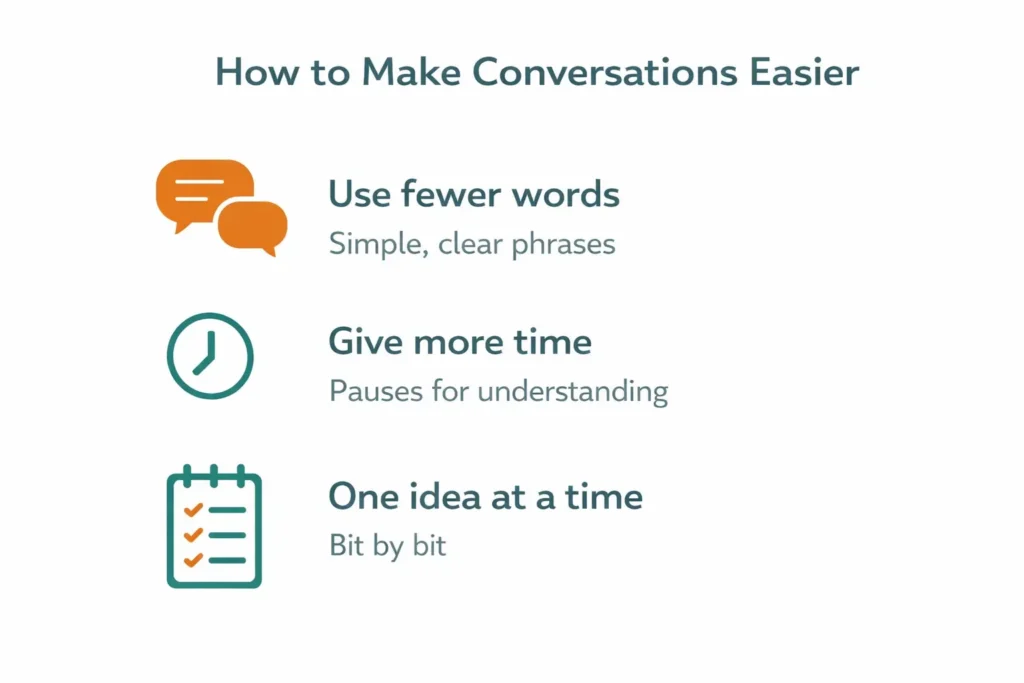
- Using fewer words
- Talking at a slower pace
- Only talking about one idea at a time
Practical Dementia Communication Tips: How to Talk Clearly and Calmly
There are a few simple ways to make conversations feel clearer and less stressful for someone living with dementia. Most of them come back to the same idea: reducing how much the person has to process at once, and helping them feel more at ease.
1. Use simple, clear sentences
Dementia can affect how someone understands and organises language. That means a sentence that feels ordinary to you may already contain more information than they can comfortably process in the moment.
Long explanations, extra detail, or several instructions at once can all make it harder to stay with the conversation. The person may lose track of what you mean, miss the main point, or become unsure what you want them to do.
That is why it often helps to keep sentences short and stick to one idea at a time rather than giving several instructions together.
For example, instead of saying:
“Let’s get your shoes on so we can go out in a minute before it gets too late.”
You could try:
“Let’s put your shoes on.”
(Pause)
“We’re going out.”
2. Slow down and give time to respond
One of the hardest parts of dementia communication is that the person may seem to have heard you, but still need more time to make sense of what you said.
That delay can be easy to misread. It may look like they are ignoring you, have not understood, or do not know what to say. In reality, they may still be processing the words.
After you speak, it often helps to pause for a short while to give them time before repeating what you said. A few extra seconds of silence may feel long to you, but it can give the other person the chance to understand, think, and respond in their own time.
3. Avoid correcting or arguing
It can be very tempting to correct something that is clearly wrong. You may feel that you are helping, keeping the person grounded, or preventing more confusion.
But with dementia, correction often does not have the effect we hope for. If the person is remembering something differently, mixing up time, or speaking from a belief that feels real to them, being corrected can feel upsetting or dismissive.
If possible, try to remember that what someone feels matters more than accuracy in most circumstances. So instead of correcting straight away, it can help to acknowledge how they're feeling, respond to the emotion and gently redirect if needed.
For example, if they say, “I need to go to work,” you do not always need to explain that they retired years ago. A calmer response might be: “You’re thinking about work. Tell me about what you used to do.”
This does not mean agreeing with something untrue. It means responding in a way that avoids unnecessary distress and keeps the interaction feeling safe.
4. Focus on tone, not just words
As dementia affects communication, the emotional side of conversation often becomes even more important. A person may not follow every word, but they can still pick up on tone, facial expression, and body language.
That means the way you speak can shape the whole interaction. With that in mind, it can really help to keep your tone calm and steady, speak gently and clearly and use open, relaxed body language.
If your voice sounds rushed, frustrated, or tense, the person may respond to that feeling even if they cannot explain why. On the other hand, a calm tone can be reassuring in itself.
Often, your presence communicates just as much as your words. Feeling safe, respected, and not rushed can make it easier for the person to stay engaged.
5. Reduce distractions before you speak
Conversations are usually easier when the environment is calm. Background noise, several people talking, a television in the room, or too much activity can all make it harder for someone with dementia to focus on what is being said.
The problem is not only hearing. It is also having to sort one piece of information from everything else around them.
Before starting a conversation, it can help to:
- Turn off the TV or radio
- Reduce extra noise in the room
- Sit at the same level, rather than calling across the room
- Make gentle eye contact before you start speaking
These small changes can make the interaction feel more manageable. Instead of competing with the environment, the person has a better chance of focusing on you.
6. Ask simple questions or offer clear choices
Questions that seem open and friendly can sometimes be hard to answer. That is because they ask the person to process the question, consider several possibilities, make a decision, and then find the words to reply.
For someone living with dementia, that can be a lot to manage, so it's best to keep questions short and offer just a couple of choices.
For example, “What would you like for lunch?” may feel too broad. “Would you like soup or a sandwich?” is usually easier.
Sometimes, if making choices feels difficult, a gentle suggestion can be kinder still. In some moments, reducing the effort involved in answering can be most helpful.
7. Use reassurance often
Living with dementia can be unsettling. A person may feel confused, unsure, or anxious without always being able to explain what is wrong. In those moments, reassurance can matter more than information.
Simple phrases such as “You’re safe”, “I’m here”, or “It’s okay” can help the person feel safer. Sometimes the most helpful response is not to keep the conversation going, but to lower the anxiety that is sitting underneath it.
When someone feels safer, they often find it easier to stay connected, even if the words still come slowly.

What to Do When Talking to Someone with Dementia Becomes Difficult
Even with the right approach, some conversations will still feel hard. The person may become confused, repeat themselves, or seem upset. In those moments, focus on lowering pressure rather than fixing the conversation.
In the moment, try to:
- Pause and give space
- Speak more slowly and use fewer words
- Use a calm, reassuring tone
- Sit quietly together if talking isn’t helping
Often, continuing to explain or ask questions can make things feel more overwhelming.
Look for what might be underneath
Communication often becomes harder when something else is wrong. It can help to gently check whether the person might be:
- Tired
- In pain or uncomfortable
- Hungry or thirsty
- Needing the toilet
- Overstimulated by noise or activity
If you notice these moments happening more often later in the day, it may be linked to what’s known as sundowning, where confusion and communication difficulties can increase in the evening. You can read more about this in our guide to sundowning symptoms in dementia.
Meeting that need can sometimes settle the situation more quickly than continuing the conversation.
Gently change the focus
If the moment feels stuck, a small shift can help as it gives the brain a break from trying to process conversation:
- Move to a quieter room
- Offer a drink or snack
- Put on familiar music
- Look through photos together
It’s okay to step away
If the conversation isn’t working, you don’t have to push through. You can pause and come back to it later. And if emotions are rising, taking a short break can help both of you reset.
What matters most is that the person feels safe and supported, even if the conversation doesn’t continue. As we've already said, feelings matter more than words.
When to Seek Help if Talking to Someone with Dementia Becomes Harder
If communication has suddenly become much harder, it’s worth speaking to a GP or healthcare professional.
A sudden change in temperament or communications may be linked to something physical rather than dementia itself, such as:
- Infection (such as a UTI)
- Pain or discomfort
- Medication side effects
- Dehydration
Organisations like Dementia UK and the NHS recommend checking for these causes first, as treating them can quickly improve communication.
When ongoing support can help
If conversations are regularly becoming difficult or exhausting, additional dementia support can make a big difference.
A trained Dementia Carer can:
- Use calm, consistent communication techniques
- Recognise early signs of confusion or frustration
- Reduce pressure during conversations
- Help keep routines steady and predictable
Often, it’s not about saying something different. It’s about having the time, patience, and experience to keep communication calm and manageable throughout the day.
How support can change daily interactions
Having the right support in place can ease the pressure on both of you, especially when conversations are starting to feel tiring or unpredictable.
Even a few hours of support can:
- Create more time and patience for conversations to unfold naturally
- Reduce stress during more difficult times of day, such as late afternoon
- Help interactions feel calmer and more familiar again
For example, a trained Dementia Carer may recognise early signs of confusion and gently slow the pace, simplify language, or redirect the moment before it becomes overwhelming.
You can learn more about what this support looks like in our guide to dementia care at home.

Bringing These Communication Tips Together
Talking to someone with dementia can feel uncertain at times, especially when conversations don’t go the way you expect.
Often, it helps to remember how dementia affects the way someone processes information. When you keep that in mind, it becomes easier to make conversations simpler to follow and help the person feel included.
That usually comes down to a few simple shifts:
- Slowing things down
- Using fewer words
- Giving time to respond
- Focusing on reassurance rather than correction
Following these approaches can help conversations feel calmer, more natural, and less stressful for both of you. If you'd like more information on dementia, we've got lots more information like this on our Care Advice Hub.
And if you need support, you don’t have to figure it out alone. With the right guidance and a little extra help, conversations can start to feel easier again.
External references
- Tips for communicating with a person with dementia - Dementia UK
- Communicating with someone with dementia - NHS
- Communicating and dementia | Alzheimer's Society
Download Your Free Guide to Dementia Care Today...
Inside you’ll find clear explanations, practical tools, and step-by-step guidance to help make life easier for you and your loved one.

Jo joined Unique Senior Care as a Carer in 2011, transitioning from a nursing background. With 25 years of experience in health and social care, including mental health and children with disabilities, Jo has embraced numerous growth opportunities within the company.
Passionate about learning and development, Jo earned a Level 5 Diploma in this field and is committed to equipping teams with the skills needed for outstanding care.
Jo’s qualifications include advanced training in people handling, risk assessment, safeguarding, basic life support, first aid, health and safety, and dementia care. Jo has also completed numerous workshops and CPD courses, such as the SCIE’s Co-Production webinar.
These accomplishments reflect Jo’s dedication to fostering a culture of safety and excellence in care.